Back to home page
Part 4: Tales from Counselor's Corner with Matthew Glidden
This interview was originally published on MorningToast.com in 2011 and has been republished here with only minor changes in dates and links.
Unsuspecting ex-GPC Matthew Glidden stumbled across what is quickly becoming a GPC Hall of Fame and made the mistake of leaving a comment...so naturally he had to be interviewed.
After three interviews it was kind of difficult coming up with new questions about Nintendo that would be interesting. Some questions are just standard but this time around I thought I'd dig a bit deeper into what life was like at Nintendo Power when the Super Nintendo was released and how that changed the culture at Nintendo HQ.
Interview with Matthew Glidden
Morning Toast: Tell the tale of how you ended up at Nintendo. Where were you at the time and how did you end up as a GPC? Was being a GPC something you wanted to do or was it just a job that wasn't something worse?
Matthew Glidden: I started phone work as a 15 year-old in early 1988, doing data surveys part-time after school. Our company, just 20 people in one call center, sat a half-mile from Nintendo of America's headquarters in Redmond, WA. I grew up in next-door Bellevue (part of the greater Seattle area), but didn't realize how close they were or that Nintendo might actually hire real people. A job that great should be awarded by some kind of lottery ticket, right?
After six months at the data company, I learned that some departed co-workers interviewed at Nintendo and one actually got hired. That was the light bulb--those guys didn't work the phone any better than me, right? Shouldn't I get in while the getting is good?
Nintendo hired many of their call center folks through local contract agencies, so that's where I applied and interviewed. During the conversation, they asked (for clarification) if I wanted to be doing customer support--in other words, hardware troubleshooting--or game counseling. Wow, GPC was an option? Join those people who know everything? Heck with you, tech support! It took less than a week to interview, wait for a response, and get a start date. (They really wanted bodies on the phones, given the approaching 1988 Christmas season)

MT: You said you worked as a GPC from 1989-1993 which spanned the release of SNES and perhaps the death of the NES. What was it like at GPC HQ when it was released? What type of changes came about...different rules, politics or anything like that? Or did it just mean you had a ton of new games to learn? How was the NES then viewed?
MG: Late in 1988, Nintendo prepared to double-down on gaming twice, first by releasing Zelda II (at Christmas) to huge customer demand and next by debuting the Game Boy (in late spring). The number of calls really grew during 1989 and they expanded the call center in 1990. At that point, more than 100 GPCs could take calls at any one time, plus another 50 customer support folks. It was a high-energy place!
SNES meant a big jump over NES, that's for sure, though Sega's emergence made a bigger impact on day-to-day phone work. (I don't remember people calling GPCs to debate the relative merits of SNES and NES, but it happened every day once Sega started promoting the Genesis.) GPCs are people too, so we all got excited to play the SNES, but still needed to know as many games as possible. Callers asked regularly about NES games well into the 90s, so you couldn't just flip a switch and stop playing them.
MT: Were you ever a featured GPC in Nintendo Power? Even if you weren't, what "Best NES Accomplishment" would have appeared with your profile?
MG: Yes, I appeared in issue #33, but after they transitioned away from counselor biographies, so am shown answering a question about the SNES game Actraiser. My best NES accomplishment would be either "Finished Solomon's Key" (the classically hard Tecmo action-puzzle game) or "Finished original TMNT in under an hour."
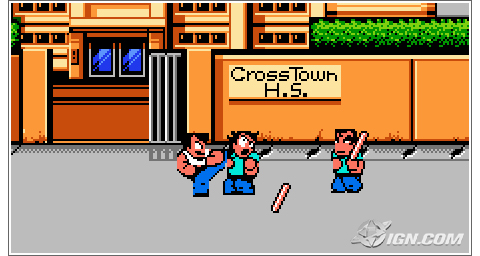
MT: What are some of your favorite NES and SNES games?
MG: River City Ransom and Super Dodge Ball still stand out from the NES days. You can imagine my excitement when Scott Pilgrim vs. The World basically remade River City Ransom for modern consoles. For SNES, Super Metroid and Super Bomberman. (My circle of friends played a ton of Bomberman for NES, SNES, TurboGrafx--you name it. Anything that could play Bomberman, we used.)
MT: All the GPCs I've talked to so far spoke about the cherished position of writing letters rather than answering the hotline, would you agree? Did answering phones make you dread going to work?
MG: True, they assigned just a small number of GPCs to the letter-writing, as it was a nice break from 9-to-5 phone work. I never dreaded going in and putting on a headset, though, since receiving calls puts you in a better position than making calls, like in my previous job. Almost all our customers wanted to talk with GPCs because they saw us as a "helpful authority," which feels pretty good as an 18 year-old, when you're usually the source of problems.
MT: Were you drinking the Nintendo Kool-Aid like the rest of us, or because you were on the "inside" did the appeal of Nintendo wear off quickly?
MG: Clocking in at NOA definitely felt like being "on the Nintendo team." The older GPCs probably looked at it differently, but even small things like a discount at the company store made a psychological difference when you're working that first "real" job. They offered custom team jackets with "GAME PLAY COUNSELOR" on the back and I bought two.
MT: Needless to say you played a lot of games during your time at Nintendo. What game do you think was the most overrated game of the time? Which game(s) could you not stand being asked about over and over?
MG: I'm sure Nintendo sold a ton of copies and people enjoyed playing it, but Zelda II: Adventure of Link should be a better bridge between NES Legend of Zelda and SNES Link to the Past. Those two games were so good! Zelda II's side-scrolling style just didn't serve its action-puzzle roots very well. It also generated many, many GPC questions because of the lousy clues offered in the game itself. On one occasion, I got five straight "WHERE IS THE HAMMER IN ZELDA II?" calls, which hopefully doesn't prejudice me against the game itself. :-)
MT: When it came to answering questions from kids like me, is there any one question that stands out in your memory to this day? Maybe one that was so weird or dumb or ridiculous...
MG: One kid claimed the family's new television allowed him to "play games in 5 dimensions" and would not accept my physics-based arguments to the contrary. Must've been a sweet TV!

MT: We all know that when the Nintendo consoles were hot everybody had one, celebrities included. Did you ever get any questions from or meet any famous (or even half famous) people?
MG: Sorry, can't remember anyone who brought it up during a call or asked for special help because they were famous. Ken Griffey, Jr. took a company tour (including the call center) one afternoon, not long before we released his SNES baseball game, but management told us in advance not to talk to him during the tour, so we just saw the group walking around.
MT: And on the topic of half famous people, did your time at Nintendo ever lead to meeting any game industry celebrities?
MG: We almost certainly worked with key people, though it's hard to remember now who was famous outside the company itself. Howard Philips, for example, was a prominent face for NOA and Nintendo Power, but did more PR than actual design. (Most of our games came from teams in Japan.) I did represent NOA at a Las Vegas Consumer Electronics Show when Stunt Race FX came out and saw Steven Spielberg move through our area. Unfortunately, he went by too fast to start a conversation.
MT: As is standard now for all my GPC interviews...what was a "good" day for Matthew Glidden at Nintendo?
MG: In 1989, days had a sine-wave rhythm, as questions came in nonstop near the top of each hour, but dropped off in-between. Good days included those breaks, since it helped GPCs collect our thoughts. We usually answered calls and played our own NES/SNES games simultaneously, so a solid hour without small breaks could make you feel scattered. (Managers scheduled breaks to start at particular times and criticized more than 15 total minutes of "down time," so you couldn't slack off for long.) If you felt helpful for people on the phone and accomplished something big in your own game, count that day as good!
...and what was a "bad" day?
By 1990, so many people played Nintendo games that calls came nonstop, except for the earliest and latest hours of each day. (We stayed open 4am to midnight Pacific time.) That didn't make days "bad," but it did mean changing your on-call habits to avoid the scatterbrain feeling. If I was really caught up in my own game (especially an engrossing RPG), taking calls could feel like a grating distraction, so it was better to turn off my screen for awhile or I'd get really snappy with people.

MT: In my mind I always pictured mini in-office game tournaments and competitions happening all the time...were there? And if so, how'd that go down and what games were popular challenge titles? Did you have an arch rival?
MG: Believe it or not, most of the competitions happened outside of work at friends' houses, at least in groups my age (18-21). I remember playing a lot of Mario Kart and the aforementioned Bomberman. At NOA, our lunch room "arcade" (with about 6 stand-up games) added a Killer Instinct cabinet at one point and that became a real focus for head-to-head fighting. Some people put in hundreds of hours practicing to keep their skills ahead of other GPCs. My biggest rivals were fellow counselors (and friends) Shane and Paul. The latter once spent all 20 hours on an off-day practicing on our KI machine; these guys were in it to win.
MT: One thing Paul Reed mentioned in his interview was the increase in GPC staff. I assume when you started in '89 it was a smaller group of folks. How did the dynamic around the office change as Nintendo Power grew and more staff was brought on board? Did you have to "break up the band" or did cliques form and West Side Story-like rumbles follow?